

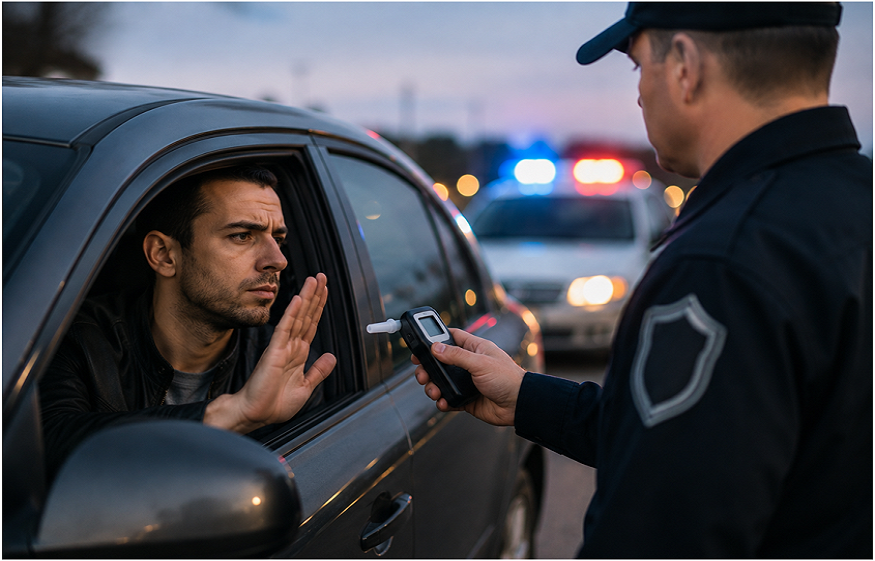
If a police officer pulls you over and suspects that you are driving while intoxicated or driving under the influence, one of the most important moments of the traffic stop may come when the officer asks you to take a breath test.
For a driver, the situation can be confusing. Should you take the test? What happens if you refuse? Can refusing a breath test prevent a DWI or DUI charge?
There is no single answer that applies in every state. Laws concerning chemical testing, implied consent, driver’s licenses, and impaired-driving charges vary throughout the country. A decision that has one set of consequences in one state may have very different consequences somewhere else.
What Is a Breath Test?
“Breathalyzer” is a commonly used term for a device that measures alcohol in a person’s breath. Police departments may use different types of breath-testing equipment depending on the jurisdiction and the stage of the investigation.
A preliminary roadside breath test may serve a different purpose from an evidentiary breath test administered after an arrest.
A DWI/DUI investigation can also involve evidence beyond a breath test. An officer may consider the driver’s manner of driving, physical appearance, speech, behavior, performance on field sobriety exercises, and statements made during the traffic stop.
As a result, a breath test is only one part of what may become a much larger investigation.
Can You Refuse a Breath Test?
Whether a driver can refuse a breath test—and what happens afterward—depends on the law of the state where the traffic stop occurs.
Many states have some form of implied consent law. Generally, these laws provide that drivers who operate vehicles on public roads have consented to certain types of chemical testing when the legal requirements for testing have been satisfied.
The consequences of refusing a test can vary considerably. The type of test, whether the driver has been arrested, the circumstances of the request, and the driver’s prior history may all matter.
That is why general advice about refusing a breath test should be approached carefully. DWI and DUI laws are not uniform across the country.
Refusing a Breath Test Does Not Necessarily End a DWI/DUI Investigation
Some drivers assume that refusing a breath test will prevent an arrest or make it impossible for the government to pursue a DWI/DUI case.
That is not necessarily true.
An officer may have other evidence suggesting that a driver was impaired. This could include observations of the driver’s behavior, the manner in which the vehicle was operated, statements allegedly made during the stop, field sobriety testing, dash-camera footage, body-camera footage, or witness testimony.
Depending on the jurisdiction and circumstances, law enforcement may also seek another form of chemical testing.
In other words, refusing a breath test does not necessarily make a driving-under-the-influence investigation disappear.
Refusal Can Create Separate Consequences
One reason chemical-test refusals can be particularly complicated is that the refusal itself may have consequences separate from the underlying DWI or DUI allegation.
In some states, a driver’s license can be suspended based on a chemical-test refusal even if the person is ultimately not convicted of driving while intoxicated.
This can create two related but distinct issues: the criminal or traffic case involving alleged impaired driving and the administrative consequences involving the driver’s license.
The distinction can be important when evaluating what happens after a DWI/DUI traffic stop.
State Laws Can Be Surprisingly Different
The differences become apparent when comparing individual states.
For example, New York has specific procedures governing chemical-test refusals and driver’s-license consequences in DWI cases. The state also distinguishes between several alcohol- and drug-related driving offenses. Someone researching the issue can see how these rules fit into the broader New York DWI framework here.
New Jersey provides another example of why drivers should avoid assuming that one state’s rules apply everywhere. New Jersey has its own implied-consent and breath-testing requirements, and a refusal can be treated as a separate offense from the underlying DWI allegation. The state’s terminology can also be confusing because people commonly say “DUI” or “driving under the influence,” while New Jersey law generally uses the term DWI. More information about the state’s approach can be found here.
These are just two examples. Other states have their own rules concerning chemical testing, implied consent, refusal penalties, and driver’s-license suspensions.
Can Refusing a Breath Test Help Your Defense?
There is no universal yes-or-no answer.
A refusal may create additional consequences, but the circumstances surrounding the request and alleged refusal can also become relevant to a DWI/DUI defense.
For example, an attorney reviewing a case may want to determine:
- Why was the vehicle originally stopped?
- What did the officer observe before requesting a chemical test?
- Had the driver been arrested?
- What instructions did the officer provide?
- What type of test was requested?
- Did the driver actually refuse?
- Were required procedures followed?
- What other evidence does the prosecution have?
- What consequences could the refusal have for the driver’s license?
The answers depend on the facts of the individual case and the law of the jurisdiction.
Read More: Is A Remanufactured Land Rover Engine Worth It? My Real-World Cost Analysis
Don’t Assume That Refusing Is a “Safe” Option
One common misconception is that refusing a breath test automatically prevents a DWI or DUI conviction.
In reality, a refusal can create its own legal problems. A driver could potentially face driver’s-license consequences while still having to defend against the underlying allegation of driving while intoxicated or driving under the influence.
At the same time, the prosecution may have evidence that does not depend on a breath-test result.
This is why simplistic advice such as “always refuse the breathalyzer” or “always take the test” can be misleading. The consequences depend on the law where the traffic stop occurred.
What About Blood and Urine Tests?
Breath testing is not the only form of chemical testing used in impaired-driving investigations.
Depending on the circumstances, police may seek blood or urine testing. These tests can become particularly relevant when drug impairment is suspected or when alcohol testing cannot be conducted through a breath sample.
The procedures governing these tests vary by state. Issues such as warrants, consent, medical procedures, collection methods, and chain of custody can all potentially become relevant.
Drivers should therefore avoid assuming that information about refusing a breath test automatically applies to every type of chemical test.
What Should You Do After a Refusal?
If you have been accused of refusing a breath test during a DWI/DUI investigation, keep all documents provided by law enforcement and the court.
Pay attention to court dates and any deadlines involving your driver’s license. In some jurisdictions, administrative proceedings concerning a license can have deadlines that are separate from the underlying DWI/DUI case.
It can also be useful to write down what you remember about the traffic stop while the events are still fresh. Details such as where the stop occurred, what the officer said, what testing was requested, and what happened afterward may become important when the case is reviewed.
Avoid discussing the details of the incident publicly or posting about the case on social media.
The Location of the Traffic Stop Matters
There is no nationwide rule that answers every question about refusing a breath test.
A driver stopped in New York may face different procedures and consequences from someone stopped in New Jersey, California, Texas, Florida, or another state. Even terminology can differ, with states using DWI, DUI, driving under the influence, driving while intoxicated, OUI, OWI, or other terms.
What remains consistent is that a chemical-test refusal can potentially affect more than the underlying impaired-driving allegation. It may also have consequences for a driver’s license and future driving privileges.
Read More: How to Inspect Used Car under $10k in Orlando
If you are facing a DWI, DUI, driving while intoxicated, or driving under the influence charge, understanding the law that applies where the traffic stop occurred is an important first step. State-specific legal advice can be particularly important when a breath-test refusal is involved.
